



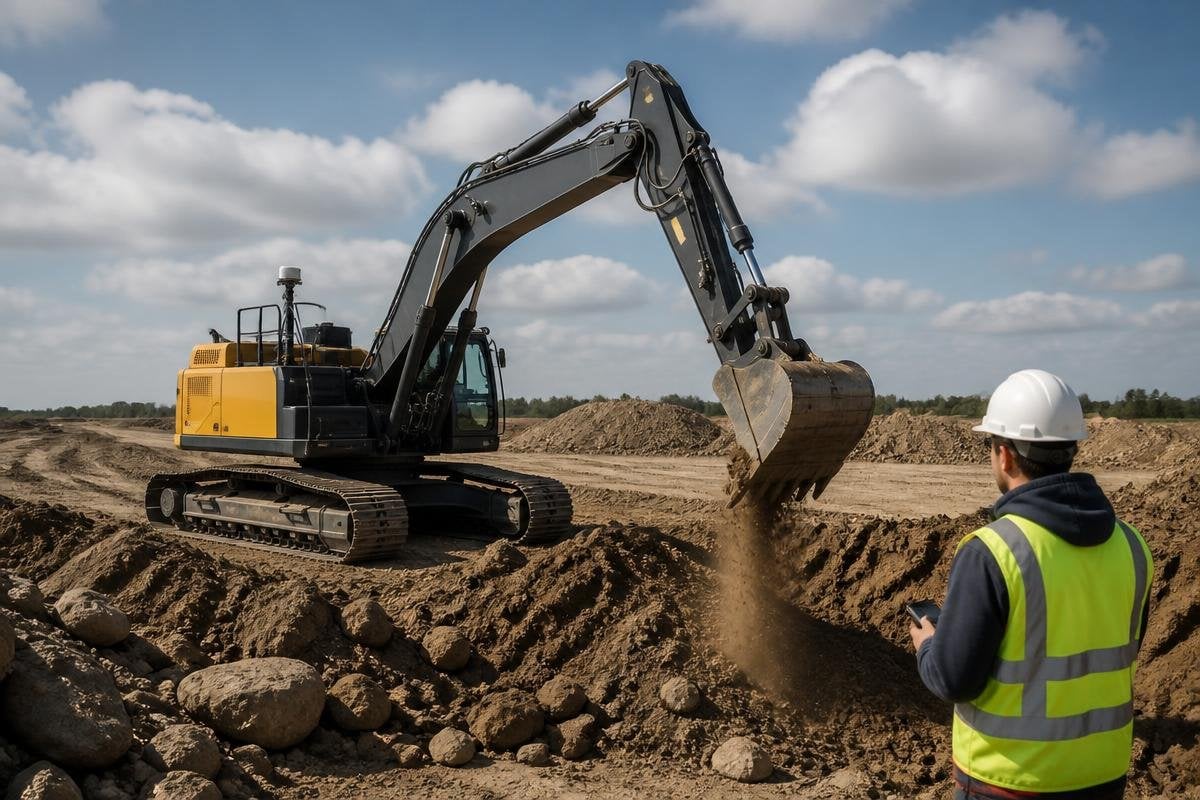
A robotic excavator has to do more than move its arm without a person in the cab. It must place the bucket, track its position, and react when soil, rock, or nearby workers change the task.
No machine, maker, price, or test result is supplied here, so this article focuses on how to judge the technology without filling gaps with sales claims.
Quick read
- Robotic control links the excavator’s tracks, boom, arm, and bucket to software and sensors.
- Supervised operation still needs a person to set the work area, check the plan, and stop the machine.
- The useful proof is completed site work, not a smooth arm movement in a controlled demo.
What makes an excavator robotic
A standard excavator relies on a person to control hydraulic valves through joysticks and pedals. A robotic excavator adds software that sends those commands from a digital plan, a remote station, or an autonomous control system.
The system must know where the excavator sits and where the bucket is. Global navigation satellite system data can give outdoor position, while cameras, LiDAR, and position sensors help track nearby objects and the machine’s moving parts. The software then compares the planned motion with the measured motion.
That loop matters because digging is rarely a clean path.
Soil changes as the bucket cuts through it. The machine may meet a buried object, lose traction, or need to shift its tracks before the next pass. A useful system can detect the change and pause, adjust, or ask for human input.
The work that matters
The first test is task completion. Can the excavator dig to a planned depth, load material into a truck, or clear a marked area while keeping the bucket inside safe limits?
These tasks need more than arm control. The excavator must manage hydraulic force, track movement, bucket angle, and the order of each action. A system that moves one joint well may still fail when the full machine has to reposition on uneven ground.
That control problem makes dated site evidence more useful than a polished digging clip. Robot24.com can connect an excavator’s autonomy claim to the task, ground conditions, and control setup behind it. The record needs to show who made each decision before the machine’s performance can be judged.
A proper report should name the task, the site conditions, the control mode, and the human role. Remote operation, supervised autonomy, and full autonomy are different claims. They should not be grouped under one label.
Where the hard limits remain
Construction sites contain people, vehicles, loose ground, slopes, dust, and changing plans. Sensors can lose a clear view. Satellite signals can weaken near structures. A tracked machine can also move in a way that changes the sensor position before the software has a clean map.
Safety adds another layer. The system needs a defined work zone, a stop method, and a way for people on site to signal that the plan has changed. A remote operator may be away from the machine, but the site still needs clear rules for access and emergency action.
Product claims also need careful reading. “Autonomous digging” could mean the machine repeats a fixed cycle after a person sets the boundary. It could mean the machine plans each bucket movement. Those are different levels of control, with different risks and labor needs.
A buyer’s check before a pilot
Use this list before you compare machines or approve a site trial:
- Name the task: Set the exact digging, loading, grading, or clearing job.
- Define control: Record which actions are autonomous and which need an operator.
- Check the sensors: Ask how the system works in dust, poor light, slopes, and weak satellite coverage.
- Set the stop rule: Confirm who can stop the excavator and how the command reaches it.
- Measure the result: Track completed work, operator time, pauses, rework, and safety events.
- Ask for failure records: Request examples of tasks the system stopped, handed back, or could not finish.
Those answers turn a technology demo into a site decision. They also show where a human remains part of the operating plan.
What proof should come next
I’d judge a robotic excavator by repeated work on a changing site, not by a single controlled run. The useful record would show the task, ground conditions, machine setup, operator input, completed work, and every safety stop.
Until makers publish that record, the new generation remains a promising control method rather than a settled replacement for a skilled excavator operator. The next number worth checking is not the bucket’s speed. It is the share of a full site task the machine can finish without hand control.